
Quarry camera network with a radio backbone
Cameras, IP speakers and MikroTik radio bridges at a quarry, on 6 metre poles so that mining machines over 4 metres tall don't break the link. Design, build, documentation.
Why this way
Running cable to the far points of the quarry would have been expensive, so I designed a radio backbone. But the radio had to be built so that the mining machines don’t disturb it. I know from earlier experience that when a 4-4.5 metre tall mining machine passes in front of an antenna or through its beam, the Wi-Fi falters or even drops. That’s why the antennas went up at least 6 metres.
In August 2026 I started by surveying and documenting the old system, and built the new layout on that.
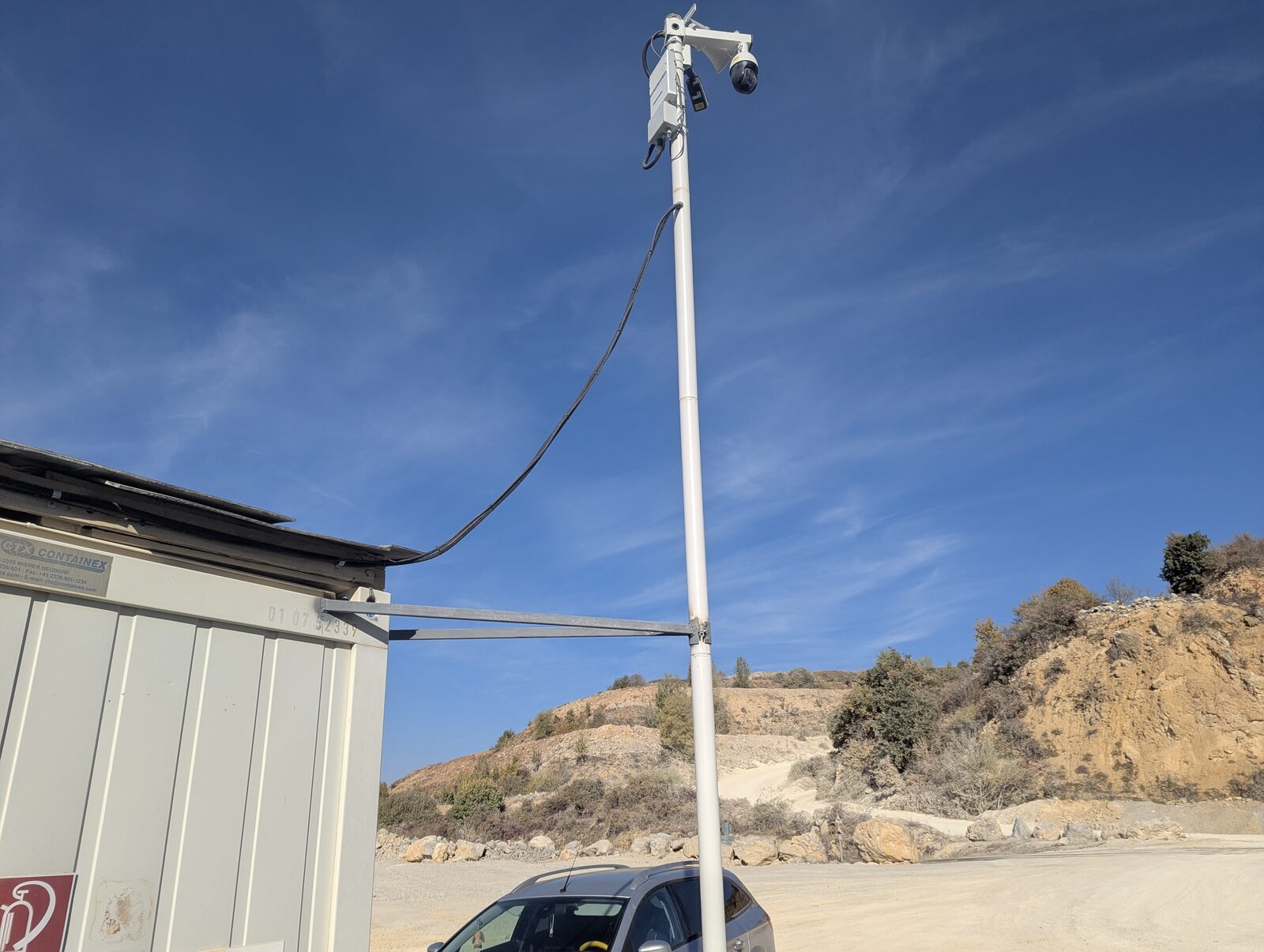
What we built
- two 6 metre poles with cameras, including a PTZ in the middle of the quarry
- IP speakers, so the dispatcher can talk to the site
- three MikroTik radio bridges (5 GHz) to the remote points
- outdoor switches, PoE, ducted underground cable and UV-resistant conduit
- a new address plan and a printed label on every device (the labels are generated from the inventory by my own script)
The design was entirely mine, and I was the project lead. We did the installation ourselves, low-voltage work only (the team has the required qualification). I don’t compromise on the ducting and the conduit: before every job I check the official requirements, and I quote accordingly.
What didn’t go smoothly
One bridge dropped now and then. It turned out the pair had been mounted the wrong way round, and the client side was scanning the wrong frequency list. I fixed that, but another problem remained: the bridge detected a false radar signal in the 5 GHz band. By the rules it then has to leave the channel for 30 minutes, which once meant about 21 minutes of outage.
I decided not to automate around it (for example by rebooting after a radar event). The DFS rule is not something to work around. The final fix is a hardware swap, when the crane truck is on site anyway.
After a site-wide power cut, one pole’s switch and cameras didn’t come back. On site it turned out the UPS on the pole had died. I bypassed it, everything came back, and the pole needs a new UPS.
In the test the speaker could be heard about 50 metres from the pole. For a 7 W horn that is the limit, and I accepted it.
Documentation
The whole project is version-controlled: inventory, address plan, per-device configuration (without passwords), the troubleshooting write-ups, and the logical topology, which I generate from a text description. The radio bridge configurations are also generated from my own template. Sensitive data never goes to a cloud on my side, at most to the client’s own cloud.